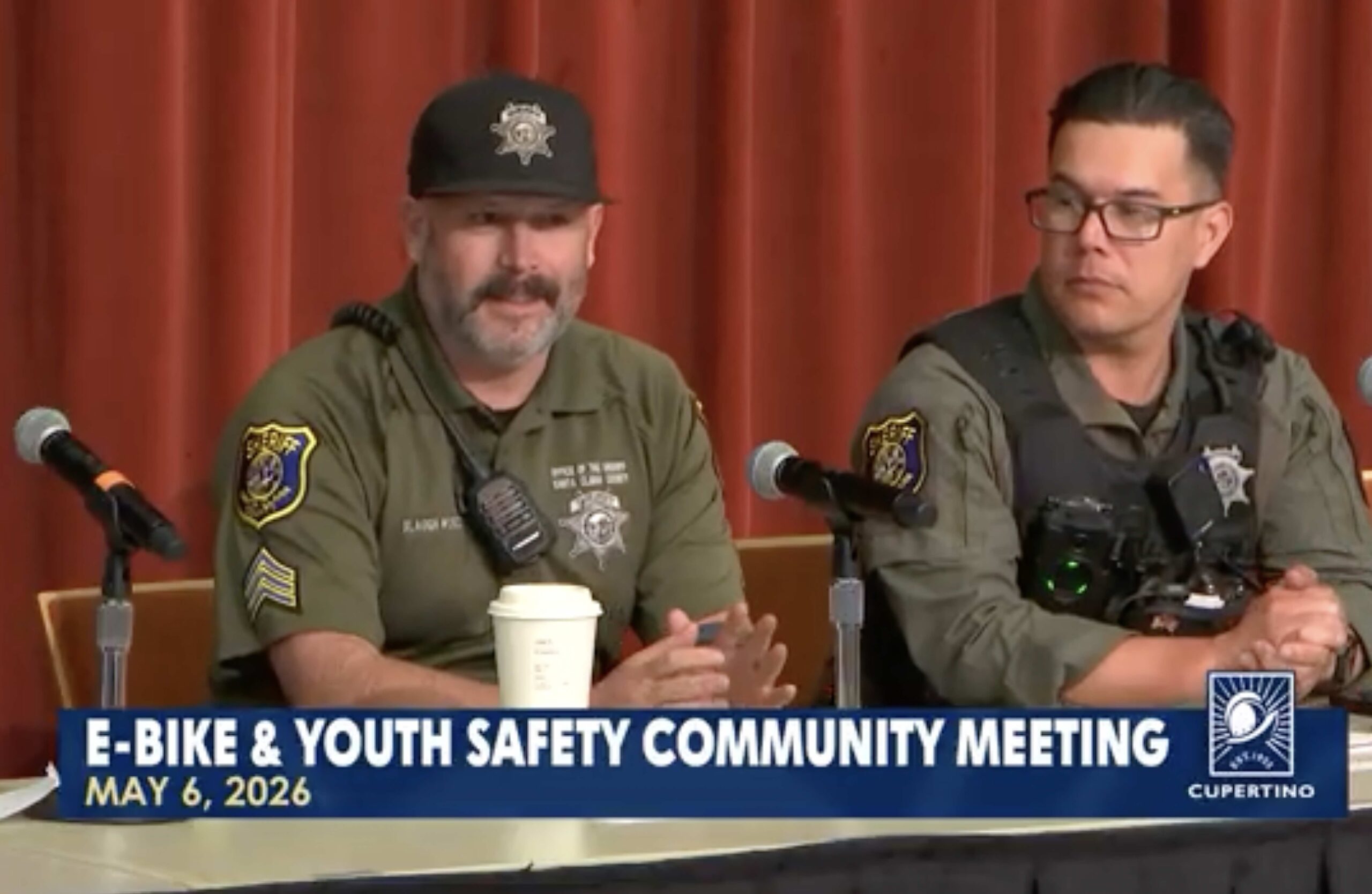
This spring, the West Valley Division of the Santa Clara County Sheriff answered questions from the Safe Routes to School Working Group members. Deputy Sgt. Alan Slaugh (on the left in the picture) answered the questions and School Coordinators Birgit Werner and Chelsea Biklen moderated. Below is a transcript of the questions and answers from that session. Some responses have been shortened for length.
Birgit Werner: We have Sergeant Alan Slaugh here with us from the West Valley Unit of the Sheriff’s Office Traffic Enforcement Unit.
How the Sheriff is different from a typical Police Department
Sgt. Alan Slaugh: For those of you who don’t [know], the Office of the Sheriff contracts its law enforcement services to Cupertino, Saratoga, and Los Altos Hills. So those three locations don’t have their own police department, like Sunnyvale Department of Public Safety has its own police department.
Outside of our West Valley Patrol Division, we have deputies who service unincorporated areas of the county, and anywhere a bus or light rail goes. We have a special operations division, a detective bureau that’s out of our headquarters in downtown San Jose, and we do security for the court system, and county parks.
My point of all that is that definitely the people that are working here, the deputies that are working here, they are more used to understanding what the dynamic of a small city is, and the importance of traffic enforcement.
Traffic enforcement and writing citations to motorists
Sgt Slaugh: I initially had a meeting with my team when I first met them, and I said, hey, I have no expectation of you going out and writing 10 citations today. Legally there hasn’t been the ability to have a quota in the traffic unit for a long, long time. But supervisors want you to go out and do work. But I told them, contrary to probably what most people think, I don’t care how many citations you write. I want you to go out, be visible, I want you to see true violations, and act how you feel is appropriate to act.
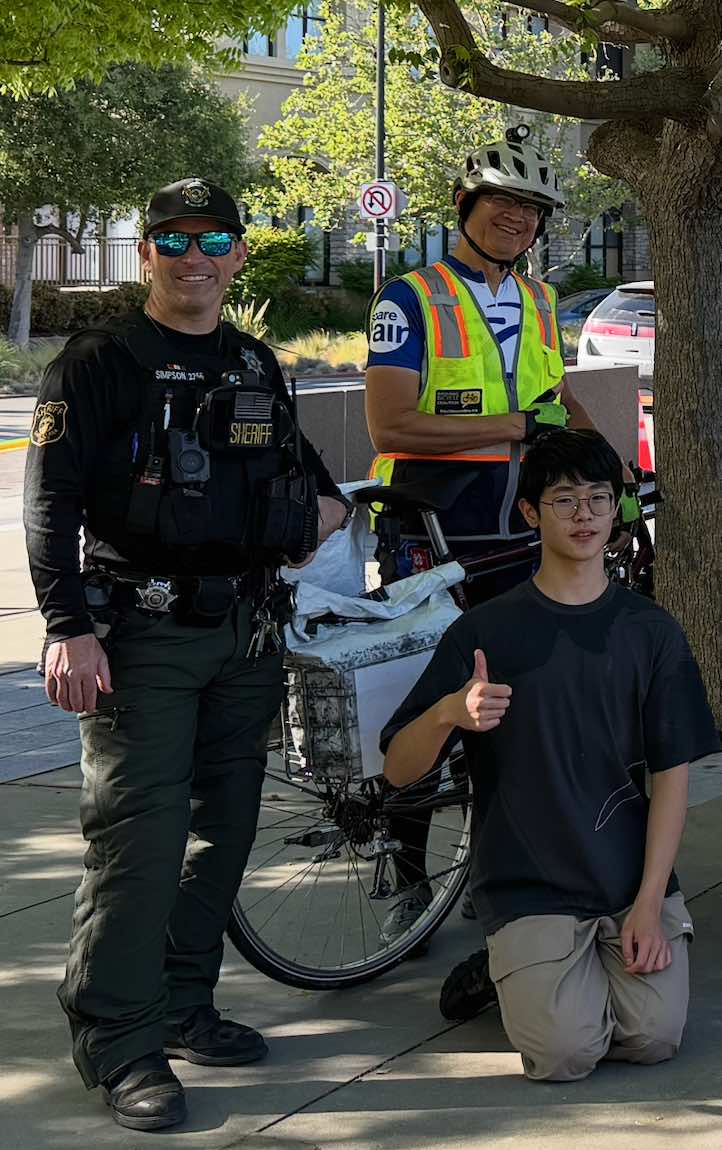
Another West Valley Sheriff Deputy, Deputy Simpson.
We love to go to coffee in the morning as a team. And… I love to… to talk. And just have connections with people. These guys will be like, hey. Sarge, school’s about to start over at this school, I gotta bounce. Super proud.
Birgit Werner: And I will reiterate having you as a partner, and having your team out there, it really helps. We do a lot of encouragement, a lot of education, but there comes a point where we need the enforcement piece of it, and having that partnership is awesome, so thank you for that.
Daylighting Law application at Collins Elementary
Chelsea Biklen: So our first question is that last time we held this Q&A session, there were questions about the daylighting law, specifically its application at Collins Elementary. Parents had been idling their car in the bike lane on Blaney Avenue and blocking the crosswalk at Forest Avenue. We were told the traffic unit would start enforcing violations after a notification to parents. Can you tell us how that enforcement is going? How many parents have been cited in the last year?
Sgt. Alan Slaugh: Sure. So one of my roles as traffic supervisor is I review all the appeals that happen with traffic parking citations. This daylighting law is a parking citation. Generally speaking, in places that have CSOs, or Code enforcement, which Cupertino does, most parking citations we kind of defer to code enforcement, or CSOs, to handle those ongoing issues. When we get a phone call about a specific complaint, and it goes to our radio dispatch, we will go out and handle it. I think what happened, or at least to my knowledge, and again, I came to the unit midway through last year, 2025, the daylighting rule went into effect January of 2025, and then there was this grace period. I think everywhere had a grace period, and tried to warn people as much as they could. But it had never existed, and it is a new thing.
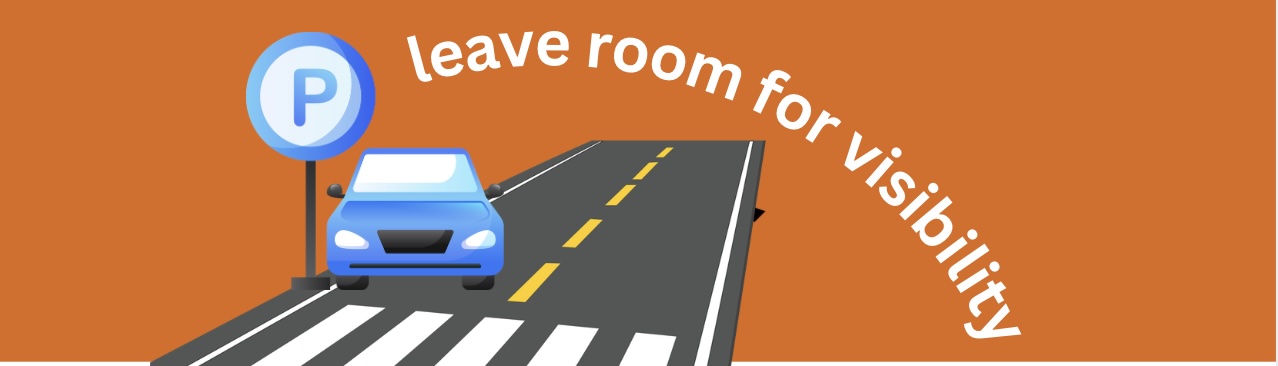
To be clear what it is, if you’re at an intersection …you cannot park within 20 feet of that approach to the intersection. After you turn right, you can park right there. That’s not against the law to park on the next side of the intersection. So, they are giving you, basically, less of a blind spot. They’re trying to open up your visual as you’re approaching an intersection, so you can see pedestrians, vehicular traffic further out in front of you that you didn’t necessarily see. It is designed to protect the pedestrians that cross on the approach side of things.
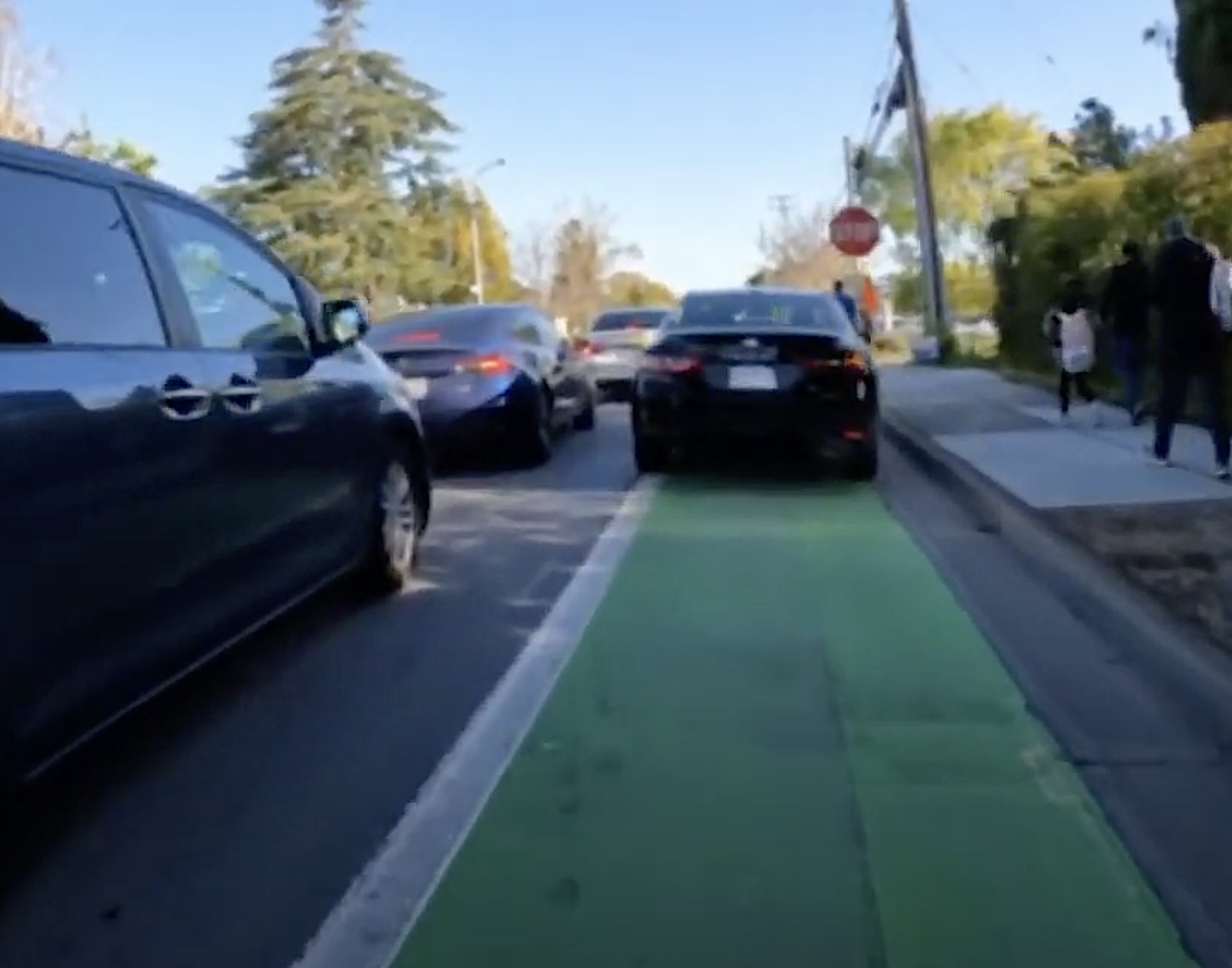
Car parked in the bike lane at the intersection of Collins Elementary and Blaney Avenue
I would be lying if I said that is a super hot topic for a traffic deputy. Traffic deputies are looking for their moving violations which is an M citation versus a P citation, which is a parking citation. And I would say the bigger violation there, in that definition, would be that they are blocking the crosswalk. And you tell them about the importance of why you don’t do that.
Recommendations for pedestrians that don’t feel safe in a crosswalk
Chelsea Biklen: Next question. What do you recommend pedestrians do, or what could the city do, about drivers that are turning right and keep inching forward into the crosswalk as a pedestrian is trying to make it across the crosswalk? Many cars don’t seem to understand how creeping close feels dangerous to the pedestrian.
Sgt. Slaugh: My unit got a hold of these questions, and across the board, they said we would cite them for California Vehicle Code 21950A pedestrian and Crosswalk. So if I enter that crosswalk with my vehicle, and there’s no island or no separation between this lane and that lane…it’s in violation. I have to wait till that pedestrian is out of the crosswalk. If we are directed to deal with an area where you guys are seeing this more egregiously than other places, we would just stand there, flag people down, write a ticket, and have a conversation. To me, the conversation is half the battle, and half the remembering of the ticket.
Chelsea Biklen: Do you have a recommendation for pedestrians in that situation? And for us at the city with communicating this?
Sgt. Alan Slaugh: So, it’s hard to tell a pedestrian what to do. But technically, it’s not a violation [for a car] until their foot is off the curb and into the street. A lot of pedestrians will just stand safely, logically, on the corner, thinking that at some point a car will stop. And they just wait until one does, and then they cross safely. In reality, that’s how it should be done.
Our thresholds are pretty significant. It is unfair to think that a pedestrian can just step out without paying attention to road traffic and without giving that vehicular driver the ability and time to slow and stop before the limit line. It is kind of as much of the pedestrian’s responsibility, except for there’s no way to cite the pedestrian for that. You should just know that it’s not smart or safe to step out if a car is coming and has not recognized you and stopped.
E–bikes and e-motos
Chelsea Biklen: There is a lot of confusion about the definition of an e-bike, the different classes, and how they differ from e-motorcycles, including how fast each can go, and who can ride them. Has the Sheriff’s Office created any education programs for people, especially parents, who are contemplating buying an e-bike, e-motorcycle, or e-scooter? And then the second is, how do or can officers distinguish an e-moto from an e-bike?
Sgt. Alan Slaugh: So this is definitely total new ground for me, particularly for a lot of regular cops out there in the world. So, a bicycle. Plain and simply. Anyone can ride. People 17 and under have to have helmets.You can ride it on the street, you can ride it on bike paths. In a lot of cities, you can ride it on the sidewalk. Pretty simple. Regular, standard, pedal bike.
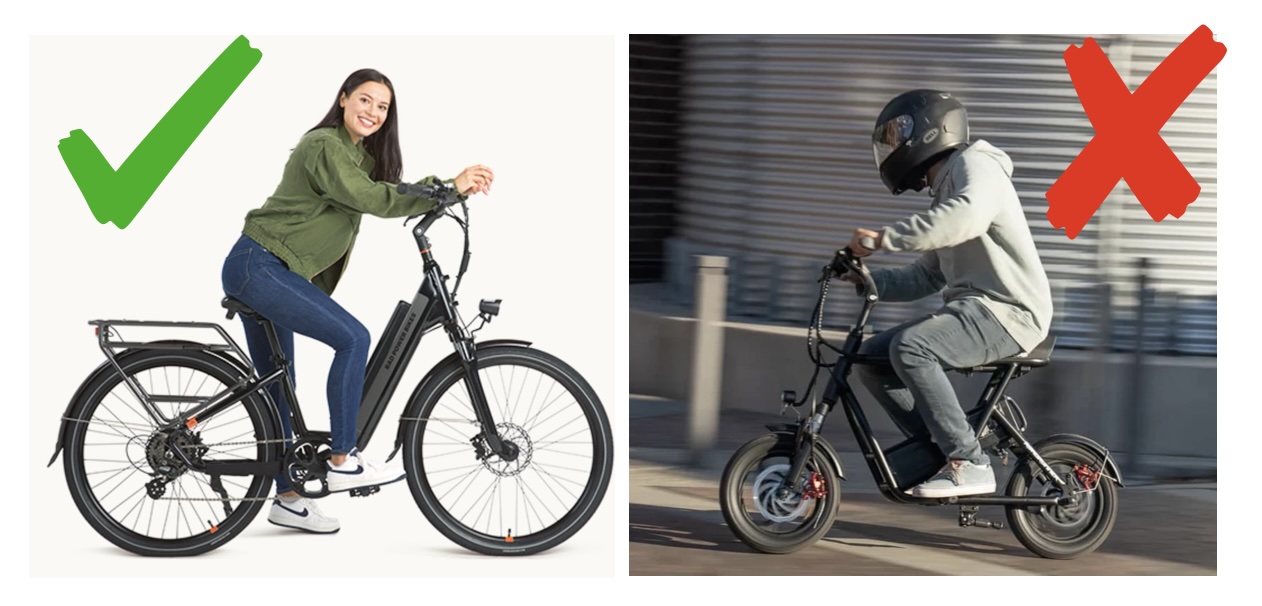
Birgit Werner: [We went] over these for this crew earlier…so I think the question was more along the lines of, how are we reaching the broader community?
Sgt. Alan Slaugh: A parent should recognize that if they can see something at a bike store, your local bike store, Trailhead, or whatever the bike store is, it’s gonna be a street-legal bike. A bike store is not selling bicycles that require a license.
Sgt. Alan Slaugh: Once you start approaching the level of Class 3 and above, technically, if we stop you, and you’re not of the age or don’t have a license, we can start towing these things. And the amount of money that, getting your bike, or e-bike, or e-motor back from a tow, it’s almost not worth it. If you haven’t learned and respect the rules of the road you shouldn’t be on something that’s going faster than 30 miles an hour. But again, even in the cop world, and I guarantee it’s the same in Sunnyvale or Santa Clara. These are very, very confusing laws.
Birgit Werner: Okay. And just to add to that, too, FUHSD, you’re starting discussions already, the five high schools locally.
Birgit Werner: Steve [Puccinelli, Assistant Vice Principal at Cupertino High School] told us yesterday that they’re already contemplating being able to tag or lock up and pound the e-motos, so they’re working on the school side, too, and they should be reaching out to you to, like, coordinate both sides. Okay. That’ll be a good discussion.
Chelsea Biklen: This is tagging on to the discussion, but what would happen today if an officer sees an e-moto user going 30 miles per hour or faster on a road or sidewalk?
Sgt. Alan Slaugh: And just being transparent and honest, if it’s not one of my traffic unit guys who knows this [topic] better, much better than I do, and much better than the average deputy, probably nothing, unless they saw something totally egregious. They would pull it over for, you know, speeding on their cell phone, or unsafe lane change, the things that they’re used to citing for, versus trying to figure out one of these laws that has become relevant in the last year or two.
Sgt. Alan Slaugh: But it all takes time. So, in all honesty, most deputies aren’t thinking about the collision that they want to prevent by doing this enforcement. But we’ve been working with Stanford, and trying to have a mechanism that’s not just a verbal, hey, this is the law. And so we’ll have a way that they can get out of the ticket, almost like traffic school, but nothing ever goes onto a record once you complete that course. I’m pretty sure the way that it is written, a parent comes with the minor to this education. I think the more and more of that starts to happen, and kids start to realize that they gotta spend an hour or two with their parent on a Saturday to hear about traffic laws, I mean, I think the word will get out. Man, just pedal or go to the actual dirt bike parks that we have in the county. Deputies don’t want to be the bad guy and give a kid a ticket.
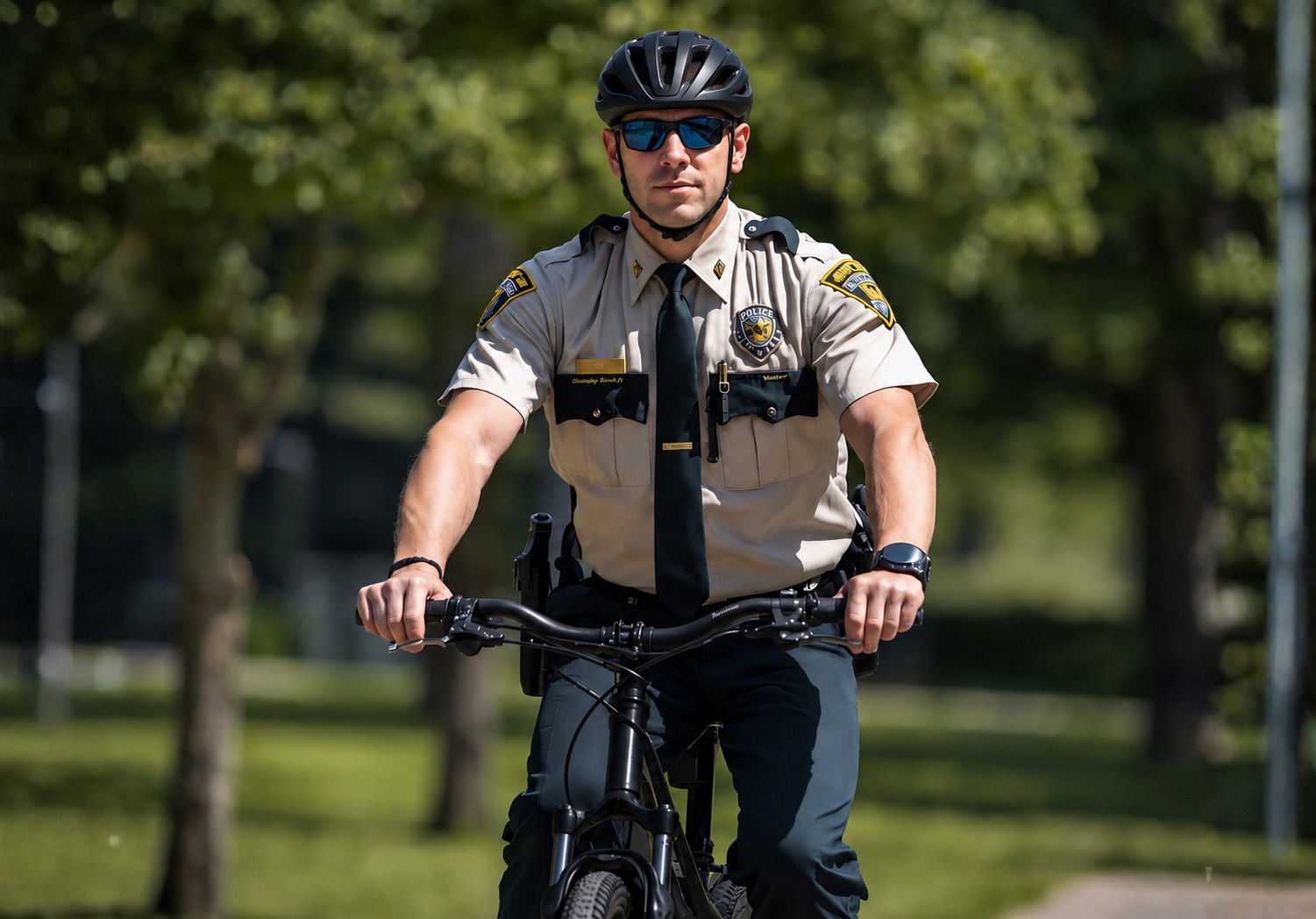
Bicycle training for sheriff deputies
Chelsea Biklen: What kind of bicycle training do officers receive?
Sgt. Alan Slaugh: So, nothing, unless you are that person who wants to go to bicycle school. There is a 40-hour, California Peace Officer Standard Training Course that if I really wanted to get certified through everything that I do, my authority as a cop, basically the post system, I would go take this 40-hour course, and it is super brutal. I mean, they take you… you have to ride a bike down, like huge amounts of steps, you have to go up and down hills, and if you are not prepared for that journey and have done some preparation, you will be sore in places that you just don’t want to be sore. There are a few people that have done that, and I think those are those are geared for places that have actual bicycle patrol assignments.
Sgt. Alan Slaugh: So large-scale cities like San Jose and San Francisco, they will have people who work their patrol beat on a bicycle. They typically don’t respond to things outside of a 4 or 5 block radius.
Advice for when you see dangerous behavior
Chelsea Biklen: Okay, final question. What can students and parents do when they see dangerous behavior, such as U-turns where kids are crossing or dropping off kids in the street travel lane? We know the deputies cannot be in all places at all times.
Sgt. Alan Slaugh: Every time I pull over a parent for driving poorly, and I recognize that there’s young ears in the car. I try to say something that will resonate not only to the current driver who made the violation but some element of education to the people who hopefully are listening in the car. Ultimately, have those conversations when you see something happening.
If it’s something that is, like, egregious and needs addressing, you can always call our non-emergency, which is 408-299-2311. The submission process through Cupertino 311 is super rad. We get people who take pictures of people in the act of a violation. The law doesn’t allow me to go back and cite that person that I’m not there watching the violation, but it really helps me see what the issue is in a clean format that comes to me in an email and then I can send it out to my troops. We take pride in the fact that Cupertino, in general, seems to care about traffic enforcement. We have a lot of traffic units.
Message to bicyclists, pedestrians, & drivers
Chelsea Biklen: So, one of the last two questions, what’s one message you would like to tell Cupertino bicyclists, pedestrians, drivers?
Sgt. Slaugh: Alright, this came from… Deputy Fitzgerald, who’s a traffic investigator, and he has done a lot, and investigated a lot, and the worst of the worst, he’s seen, so…his message to everyone is road safety is a shared responsibility.
So whether you’re behind the wheel, on two wheels, Or on foot. Please stay alert, respect everyone’s space. To ensure we all arrive safely to our destinations, we have to look out for each other.
Which means drivers giving cyclists at least 3 feet of space, pedestrians staying visible. Because the road belongs to all of us. And I added, stay off your phones.